
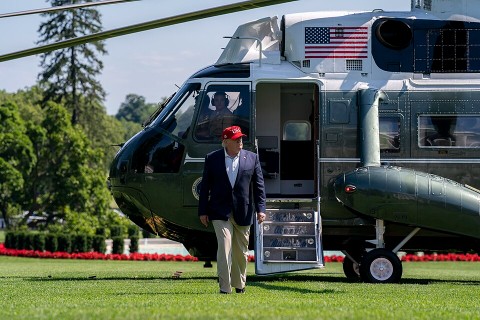
In an unexpected announcement, former U.S. President Donald Trump declared his intention to engage in a dialogue with Taiwan’s President Lai Ching-te, a move that could potentially stir diplomatic tensions with China. Speaking to reporters at Joint Base Andrews in Maryland before boarding Air Force One, Trump mentioned, “I’ll speak to him… We’ll work on that, the Taiwan problem.” Taiwan’s foreign ministry responded positively, stating Lai would welcome the opportunity to converse with the U.S. leader.
Since the United States officially switched its diplomatic recognition from Taipei to Beijing in 1979, no direct communication has occurred between the sitting presidents of the U.S. and Taiwan. However, Trump previously disrupted this status quo in late 2016, when he, as president-elect, accepted a congratulatory call from then-Taiwan President Tsai Ing-wen, leading to a diplomatic complaint from China. Beijing perceives Taiwan as a breakaway province and has been critical of U.S. military support to the self-ruled island.
Trump’s recent comments mark the second occasion within a week that he has mentioned plans to speak with Lai, clearing up any initial confusion regarding whether his earlier statement was a slip of the tongue. Though no call has been scheduled, the White House and China’s embassy in Washington have yet to comment on when such a conversation might take place or its potential topics. Amidst this backdrop, Trump has boasted about his positive rapport with Chinese President Xi Jinping and has not yet committed to a significant weapons sale to Taiwan, estimated at $14 billion, further clouding U.S. support for the island.
In response, Beijing has reportedly delayed approving a proposed visit by Elbridge Colby, the Pentagon’s undersecretary of defense for policy, to China, linking the decision to Trump’s stance on the arms deal. Meanwhile, Trump has approved more arms sales to Taiwan than any previous U.S. president, viewing these transactions as a potential bargaining tool. Yet, his mixed messaging has created uncertainty in Taipei. Lai, considered a separatist by Beijing, expressed his administration’s commitment to maintaining peace in the Taiwan Strait, accusing China of destabilizing the region with its military expansion.
Taiwan remains a crucial ally for the U.S., both strategically and economically, as it ranks as the fourth-largest trading partner. The island’s contributions to the global economy are underscored by its exports of advanced semiconductors to the U.S. Under U.S. law, the nation is obliged to provide Taiwan with defensive capabilities, a policy supported by both Republican and Democratic lawmakers. Lai emphasized Taiwan’s democratic values, stating, “No country has the right to annex Taiwan. The people of Taiwan pursue a democratic and free way of life, and democracy and freedom should not be regarded as provocation.”