
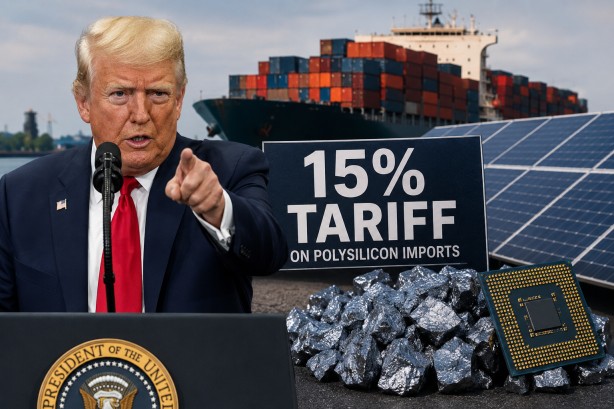
In an effort to bolster domestic industries and reduce dependency on China, US President Donald Trump has announced a 15% tariff on imports of products containing polysilicon. This tariff, set to be implemented on December 4, targets a crucial material used in the production of semiconductors and solar panels. Polysilicon, a highly purified form of silicon, is integral to the manufacturing of semiconductors that drive artificial intelligence technology and data centers, as well as solar cells and panels. Notably, China dominates the global production of this material.
The new policy introduces specific minimum import prices: $21 per kilogram for polysilicon, $100 per kilogram for polysilicon ingots and wafers, $0.22 per watt for solar cells, and $0.38 per watt for solar modules and panels. The US administration asserts that these measures are designed to enhance the competitiveness of domestic polysilicon production and solidify supply chains critical to both economic stability and national security.
China has expressed discontent with the imposed tariff, accusing the United States of exploiting national security justifications to hinder Chinese enterprises. Beijing warns that such protectionist actions could potentially strain trade relations between the two nations. Despite these tensions, the US continues to push for policies that encourage local manufacturing capacities.
Within the United States, major polysilicon manufacturing facilities are operated by Hemlock Semiconductor in Michigan and Wacker Chemie in Tennessee. As part of the new strategy, the US government is also positioned to create incentives for companies that choose to invest in domestic polysilicon and related manufacturing facilities. This policy shift aims to invigorate the local industry and reduce foreign dependence for critical materials.
This tariff decision comes on the heels of China’s robust growth in export sectors, especially in electronics, artificial intelligence-related products, and other high-value manufacturing areas. As global competition intensifies, the US seeks to secure its supply chain resilience and ensure the sustainability of its technological and manufacturing sectors.