
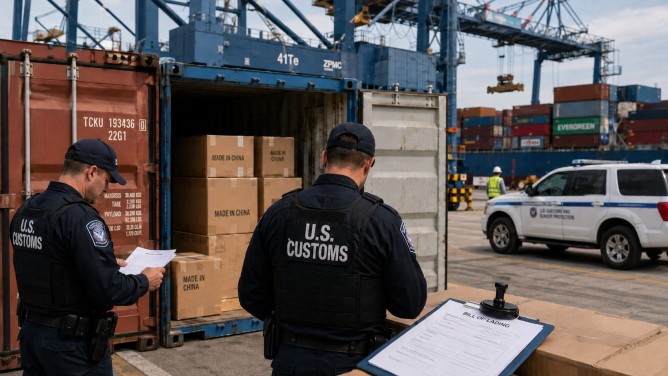
The United States has leveled accusations against 38 nations and the European Union, claiming they form a “shadow transshipment network” that facilitates the entry of Chinese goods into the U.S. market, circumventing elevated American tariffs by passing through intermediary countries. A report titled “The Great Transshipment Scam” assesses the potential value of these alleged practices at around $60 billion, suggesting that they have caused significant losses in U.S. tariff revenue.
Among the countries and territories identified in the report are major global players like India, Canada, the European Union, Israel, Japan, Mexico, and South Korea. Also included are Taiwan, Brazil, Indonesia, Malaysia, Thailand, Turkey, and Vietnam, along with Argentina, Azerbaijan, Bangladesh, Cambodia, Chile, Colombia, Costa Rica, the Dominican Republic, Georgia, Jordan, Kazakhstan, Kenya, Laos, Morocco, Myanmar, Oman, Panama, Peru, the Philippines, Singapore, Sri Lanka, Switzerland, the UAE, and Uzbekistan.
The document claims that in 2025, approximately $67 billion worth of goods bound for the U.S. were rerouted through significant hubs such as Mexico, India, and Vietnam, originating from China. It is estimated that this maneuvering led to a loss of about $28 billion in U.S. tariff revenues. The report further singles out the Pune-Gujarat-Chennai corridor in India, alleging that Chinese shipments of products like electric pumps and compressors have not only benefited local businesses but also heightened competitive pressures on U.S. manufacturers.
As a potential countermeasure, the United States is contemplating a series of responses, including intensified inspections and interdiction efforts, the imposition of additional tariffs, sanctions, and the possibility of restricting market access for countries that are found to assist in tariff evasion. This approach underscores the seriousness with which the U.S. views these alleged transshipment activities and its determination to protect its economic interests.