
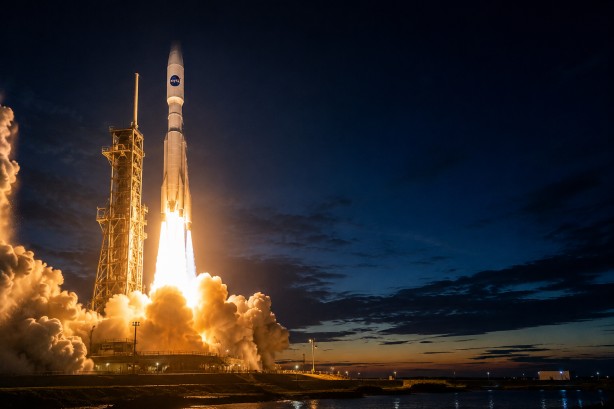
The Nancy Grace Roman Space Telescope, a major undertaking by NASA, has embarked on its mission after a successful launch from Florida’s Kennedy Space Center. This $4.3 billion project aims to delve into the mysteries of the universe, focusing on exoplanet exploration, the formation processes of planets and galaxies, and other cosmic phenomena. Launched aboard a SpaceX Falcon Heavy rocket, the observatory is set to travel nearly a million miles from Earth, marking a significant new phase for a mission that has been in development for nearly ten years.
Unlike its predecessors, the Hubble and James Webb Space Telescopes, Roman is designed to complement their work rather than replace them. Equipped with a 300-megapixel infrared camera, the telescope will capture images with the resolution akin to Hubble’s, yet it will cover a much larger field—over 100 times more expansive. Each image will span an area of the sky approximately 1.5 times the apparent size of the full Moon. Additionally, the telescope boasts a coronagraph, a tool that can block the overwhelming glare of stars, permitting scientists to examine the planets orbiting them more closely. This capability could lead to the discovery of previously hidden worlds, such as older and cooler planets in nearby orbits to their stars.
Roman’s journey will take it to the Sun-Earth Lagrange Point 2, a stable point in space also utilized by the James Webb Space Telescope. From this vantage, it will conduct diverse observations over its five-year primary mission, with the possibility of extending its operation. Scientists anticipate that Roman will shed light on complex topics such as dark matter, dark energy, distant galaxies, supernovae, black holes, and exoplanets. Its extensive field of view is expected to identify new astronomical targets for Hubble and Webb to investigate in greater detail.
The scientific community eagerly awaits Roman’s first images, projected to be available by early 2027 after a period of testing and calibration. NASA intends to release these images to the public, offering both researchers and amateur astronomers new data to explore. The mission’s success is particularly noteworthy given that it once faced potential cancellation due to proposed cuts to NASA’s science budget. However, Congress intervened to secure the necessary funding, enabling the mission to proceed. The launch of Roman marks a pivotal moment in NASA’s ongoing efforts to unravel the complexities of the universe, from its expanding nature to the intricacies of planet formation over billions of years.