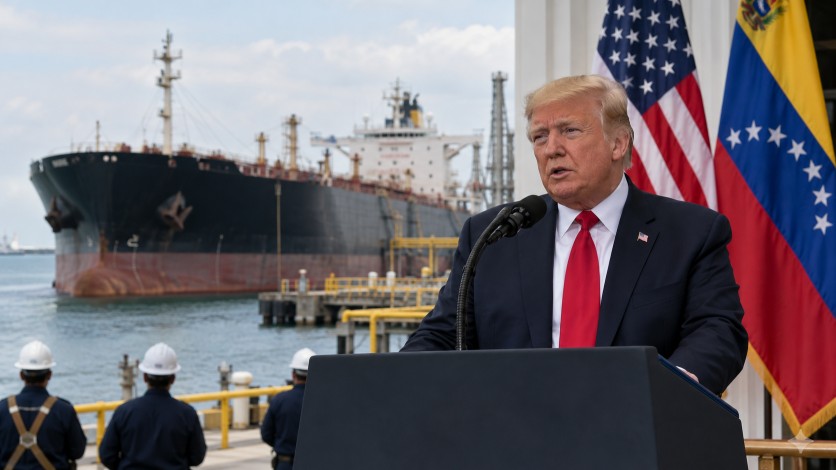
At a campaign rally in Corpus Christi, Texas, President Donald Trump announced a new oil agreement with Venezuela, highlighting it as a significant achievement for American energy policy. Trump pointed to an oil tanker visible from the Texas coast, claiming it carried one million barrels of Venezuelan oil. He touted the agreement as a historical triumph that would supply billions of barrels of oil to the United States without costing American taxpayers.
Trump suggested that this deal could pave the way for Venezuela to become the 51st state of the United States, envisioning prosperity for the South American country under the agreement. This development follows a US military operation in January that led to the capture of former Venezuelan President Nicolás Maduro, who was brought to New York to face criminal charges. The deal was made with Venezuela’s interim government after Maduro’s detention.
The agreement, according to Trump, is intended to bolster US energy dominance and alleviate rising domestic fuel prices, which have been affected by tensions with Iran and disruptions in global oil supplies. However, the deal has attracted criticism over concerns regarding Venezuela’s political future. Critics argue that the US administration appears more focused on securing Venezuelan oil than ensuring a democratic transition, noting that the country has not held elections since Maduro’s capture.
Global energy markets have been strained due to disruptions in oil shipments through the Strait of Hormuz, a key maritime route responsible for about 20% of the world’s oil supply. These disruptions have contributed to escalating energy prices, impacting consumers worldwide. In this context, Trump is framing the Venezuelan oil agreement as a crucial component of his energy strategy.
Despite Trump’s optimistic presentation, questions remain about the long-term economic impact of the deal, the future of Venezuela’s political landscape, and whether it will significantly affect fuel prices in the United States. As this situation unfolds, the implications for both Venezuela and the US continue to be a topic of debate and scrutiny.