
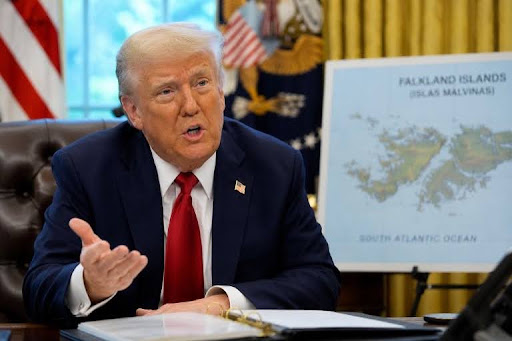
Donald Trump has recently suggested a potential shift in the United States’ longstanding support for Britain’s claim to the Falkland Islands, a move that could potentially complicate the historic alliance between the US and the UK. When questioned about whether Washington’s position on the South Atlantic territory might be reevaluated, Trump mentioned that he routinely reviews all policies, implying that this issue is just one of many under consideration. Although the official US stance is neutral regarding the sovereignty dispute between Britain and Argentina, in practice, it has acknowledged British administration of the islands since 1833, with the exception of a brief period during the 1982 war initiated by Argentina’s invasion.
Trump’s remarks are being interpreted as a possible indication that his administration might use the Falkland Islands issue as a negotiating tool to persuade the newly appointed British Prime Minister, Andy Burnham, to bolster the UK’s defense spending and NATO contributions. A spokesperson for Prime Minister Burnham reaffirmed the UK’s unwavering stance, emphasizing that the islanders consider themselves British and wish to remain a UK overseas territory. The spokesperson also reiterated the UK’s commitment to fulfilling its international defense obligations.
These developments come in the wake of a report quoting an unnamed US official, suggesting that the US might reconsider its position if the UK does not meet its defense spending commitments. This speculation arises amid discussions that the UK’s Chancellor may revise a previous pledge to increase defense spending to 3% of GDP by 2030, ahead of a forthcoming budget announcement. Throughout Trump’s presidencies, he has consistently urged allies to raise their defense expenditures, aligning with an earlier agreement among allies to boost defense and security spending to 5% of GDP by 2035.
Any alteration in the US stance on the Falklands would carry significant symbolic importance. During the conflict in 1982, the US provided strong diplomatic support to the UK in its efforts to reclaim the islands from Argentina, a war that resulted in considerable casualties and solidified a close political alliance between the US and UK leaders of the time. In recent years, Trump has fostered a close relationship with Argentina’s president, who has openly advocated for Argentina’s claim to the islands. Trump has previously extended substantial financial assistance to Argentina, contingent upon political developments, and later relaxed trade restrictions on Argentinian beef imports.
The issue of the Falkland Islands remains contentious, as evidenced by a 2013 referendum in which the islands’ residents overwhelmingly expressed their desire to remain under British rule. Tensions resurfaced following a provocative gesture by Argentinian athletes after a sporting event, which led to a fine by football’s governing body. Despite these challenges, the UK’s position remains firm, and any shift in US policy could have far-reaching implications for the region and the broader US-UK relationship.