
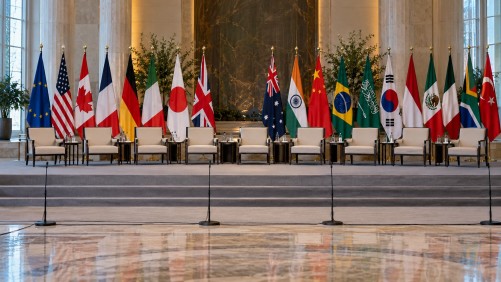
The United States has opted to cancel the traditional group photograph at the G20 foreign ministers’ meeting in Atlanta, following a refusal from several countries to appear alongside Russian Foreign Minister Sergei Lavrov. The move comes as tensions persist over Russia’s ongoing war against Ukraine.
US Secretary of State Marco Rubio made the decision after approximately one-third of the participating countries, including the United Kingdom, Australia, and several European Union members, expressed their intent to boycott the event or stage a walkout if Russian representatives were included in the photograph. The cancellation underscores the divisions within the G20 over Russia’s international standing and the broader geopolitical climate.
During the opening of the meeting, Rubio emphasized the necessity for unity amid escalating economic and geopolitical challenges, warning of interconnected crises impacting global security and trade. The European officials’ opposition to the photograph highlighted their stance against normalizing relations with Russia while the conflict in Ukraine persists. German Foreign Minister Johann Wadephul and UK Foreign Secretary Ed Miliband both indicated their unwillingness to participate in a group photo with Lavrov.
Australian Foreign Minister Penny Wong also criticized Russia’s actions during her opening remarks, labeling the war as unjustified and noting its repercussions on international markets and global food security. Australia’s support for the US decision to cancel the photograph further reflects its opposition to legitimizing Russia’s actions through symbolic gestures.
This diplomatic discord signals ongoing challenges in reaching consensus at the G20, particularly concerning Russia’s role and the Trump administration’s efforts to mend relations with Moscow. Additional disputes, including Russia’s opposition to Poland’s potential G20 membership and the exclusion of South Africa, have further complicated discussions and may hinder the issuance of a joint communique at the meeting’s conclusion.
The absence of South Africa, a founding G20 member, from the invitation list has added to the tensions, particularly following disagreements during South Africa’s G20 presidency in 2025. These divisions may also impact preparations for the upcoming G20 leaders’ summit in Florida, which will be hosted by US President Donald Trump.